From Availability to Adoption
IKEA circularity through an implementation lens
Circular Economy · Adoption · Behaviour Change
Independent analytical project · 2026

01
The situation
IKEA has developed circular initiatives that support product life extension through repair, spare parts, buy-back, resale and related services.
These systems create practical alternatives to a linear pattern of buy, use and discard.
But circular outcomes do not happen through infrastructure alone.
A repair option only extends product life if someone uses it. Spare parts only matter if customers know they exist and can act on that knowledge. Buy-back and resale depend on people choosing those routes rather than disposal.
That creates an implementation question beyond whether the circular solution exists.
02
The implementation question
“What has to happen between making a circular option available and people actually using it?”
This shifts the analysis from the existence of infrastructure to the conditions surrounding adoption.
The organisation can create the system.
But some of the intended outcome still depends on what happens when that system meets the customer.
“Availability creates an option. It does not guarantee adoption.”
03
The analysis
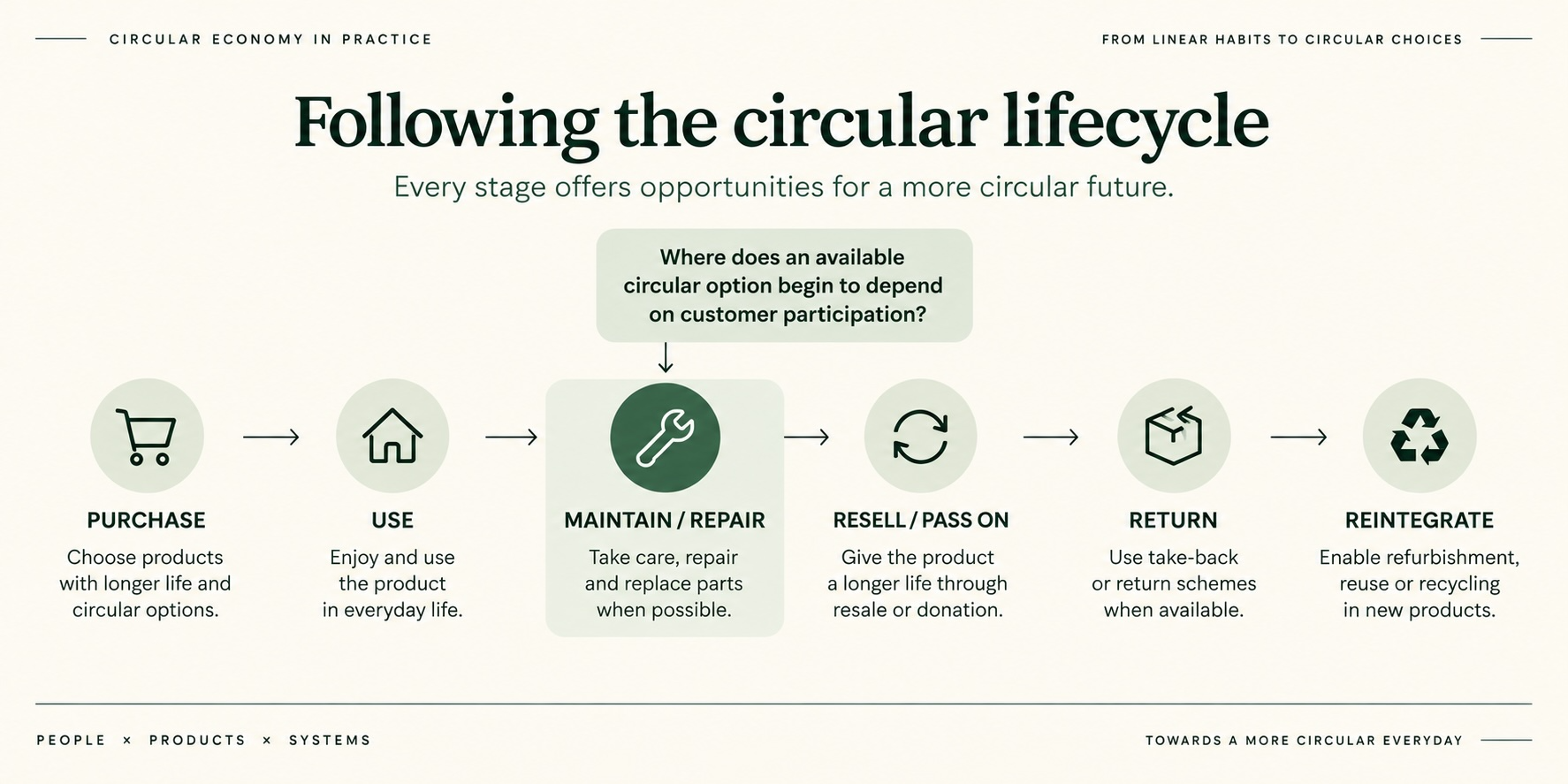
I examined IKEA’s circular initiatives through the customer behaviours required for those initiatives to contribute to their intended outcomes.
That meant following the logic beyond the initial purchase:
- Use
- Maintain
- Repair
- Resell or Return
- Re-enter circular flows
At each stage, the question became less about whether an option technically existed and more about what the customer would need to notice, understand and do for the circular pathway to continue.
“A system can be operationally available while still depending on human participation to produce its intended outcome.”
04
What the analysis revealed
The analysis identified a potential gap between solution availability and solution use.
Circular services can require customers to actively find information, understand the option and initiate the next step. That creates points where an otherwise sound circular pathway can become harder to follow.
This does not establish that IKEA’s circular initiatives are ineffective.
It identifies a more useful implementation question:
“Has the experience surrounding the solution made the intended behaviour sufficiently visible, accessible and actionable?”
That distinction matters because providing a solution and achieving adoption are not the same implementation condition.
05
Intervention thinking
The analysis therefore did not begin by proposing another circular service.
Instead, it explored how existing options could become easier to encounter and act upon throughout the customer journey.
Potential interventions included bringing maintenance guidance, repair reminders, resale prompts and return pathways closer to relevant moments in product use, and making circular options more visible through ordinary customer touchpoints.
The intervention logic was:
- Existing solution
- Required behaviour
- Conditions supporting that behaviour
- Adoption
“Before adding another solution, examine what is happening between the existing solution and the behaviour it requires.”
06
What this developed in my practice
This project sharpened my interest in a particular implementation problem:
“A solution can exist without the conditions required for people to adopt it.”
That question is transferable wherever an intended outcome depends partly on what people subsequently do — whether the intervention is a service, programme, process, policy or technology.
The IKEA analysis became one of the foundations for my developing work on the Adoption Bridge, which examines what happens between a sustainability intervention and the participation it requires to function.
07
Evidence & boundaries
This was an independent analytical project using publicly documented IKEA circularity initiatives as an illustrative case.
“IKEA was not the commissioning client.”
The project did not involve access to IKEA’s internal customer, behavioural or operational data. It therefore identifies implementation hypotheses and opportunities, rather than establishing why IKEA customers do or do not use particular services.
The proposed interventions were not implemented or evaluated within IKEA as part of this work. No claim is made that they changed customer behaviour, increased participation or produced measured environmental outcomes.
“The value of the case is the analysis itself: examining what must happen between a sustainability solution being available and people actually using it.”
Project details
- Context
- Circular Economy / Business Model Innovation
- Focus
- Circular consumption · Customer participation · Adoption
- Systems examined
- Repair · Spare parts · Maintenance · Resale · Buy-back · Return
- Type of work
- Independent analytical project
- Year
- 2026